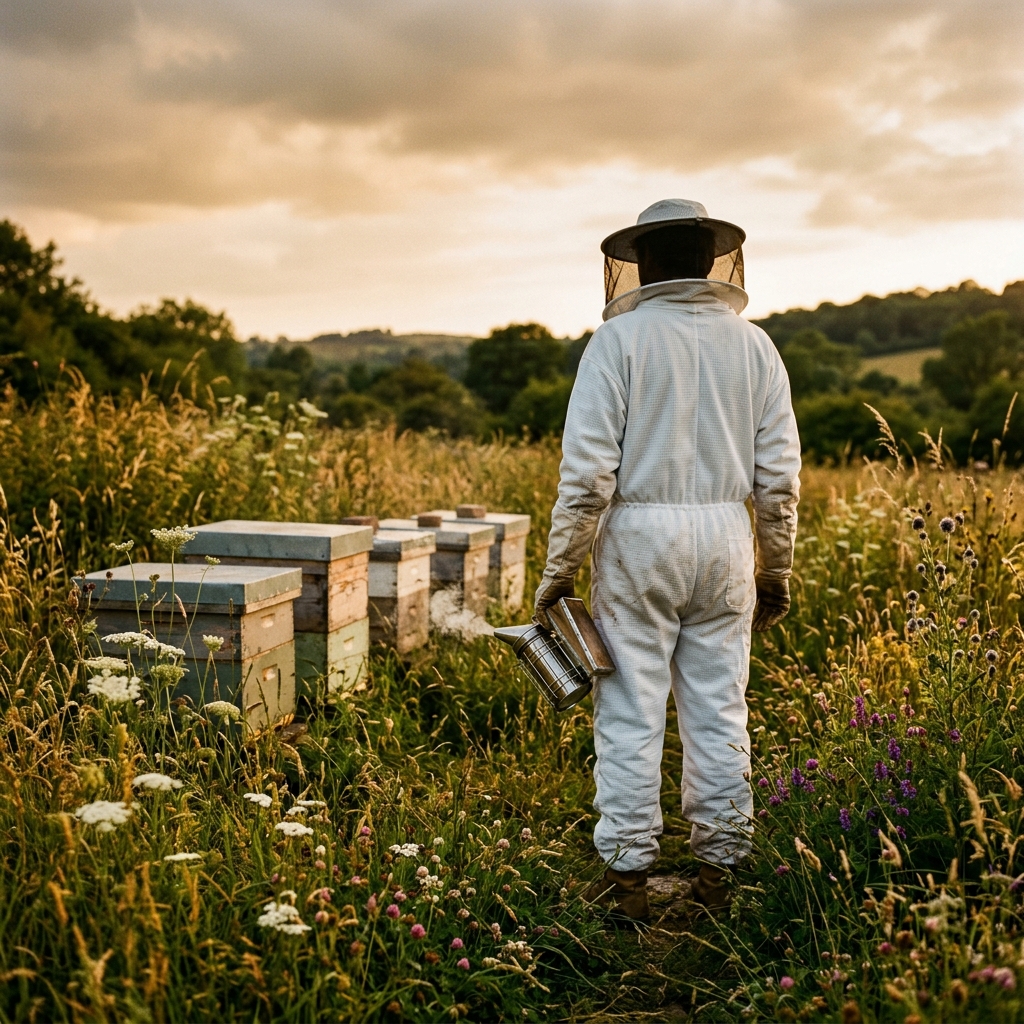
Seventeen Years, Fourteen Colonies, No Social Media.
My name is Aaron. I keep bees because I find the work genuinely interesting: the biology, the seasonal rhythm, the problem-solving when something goes wrong. I started this journal because most beekeeping content online is either oversimplified or written by people who've never actually had a colony abscond mid-July.
I prefer to stay out of the spotlight. If you're here for the information, that's all I care about.
How I Got Here
I stumbled into beekeeping in 2009, the way most people do, when my neighbour had a small colony and thought I might enjoy helping one afternoon. I was hooked immediately. Not by the honey, interestingly, but by the colony structure. The way individual bees aggregate into a single decision-making organism that is both chaotic and perfectly organised. I found it genuinely strange and wanted to understand it better.
My first winter I lost the colony. Standard beginner error: I left the entrance reducer on too tight during a warm spell in January, the cluster overheated and couldn't ventilate properly, and by February they were gone. I was devastated. I also learned more from that loss than from the next three successful winters combined.
By 2013 I was running three colonies out of my backyard. By 2017, I had arranged a lease on a corner of a working farm about six miles away, which gave me access to much better forage, particularly the white clover fields, which produce the cleanest honey I've ever extracted.
I now manage 14 colonies across the two sites. I don't sell in bulk to a packer. I bottle everything myself and sell direct at a local farmers' market and through word-of-mouth. The margins aren't impressive but the quality control is complete, which matters to me.
What I Believe About Beekeeping
The single most important skill in beekeeping isn't knowing the right answer; it's recognising when you don't know the answer yet, and not making a decision until you do. Bees tolerate a lot of inaction. They don't tolerate much bad action.
My Management Principles
My Hive History: The Short Version
One Langstroth, One Lost Colony
Started with a single 10-frame Langstroth from a retiring beekeeper. Lost it by February. Spent the winter reading everything I could find.
First Successful Overwintered Colony
Got through winter with two colonies. Made my first real honey harvest, about 28lbs from one super. I thought it tasted like nothing I'd bought in a shop.
Bought My First Warré Kit
Built two Warré hives from a kit and installed packages. Eye-opening experiment in low-intervention management. I still run two Warrés alongside my Langstroths.
Farm Lease: New Site
Began leasing a section of working farmland 6 miles from home. Access to white clover fields transformed my wildflower and clover honey output substantially.
Full Switch to Organic Mite Treatments
Invested in a ProVap 110 oxalic acid sublimator and completed the switch to organic IPM across all hives. Mite counts have stayed manageable since.
Started Blosmo
Started writing these notes down properly. If I'm writing it out for myself anyway, it made sense to publish it in case someone else finds it useful.
The Apiary at a Glance
Why No Face Photo?
I'm a private person. The bees don't care what I look like and neither should you. If the information is useful, that's what matters. My neighbour knows what I look like. That's enough.
Reach Out
If you have a specific hive question, a swarm to report, or just want to talk bees, the contact page is open. I try to respond within 48 hours when I'm not deep in a super stack.
Contact Aaron